
Wednesday, May 8, 2013
Three requirements of the baptized
These three things God requires of all the baptized: right faith in the heart, truth on the
tongue, temperance in the body.

Monday, May 6, 2013
St. George, pray to God for us!
See the April 2011 Ortho
Thought entry for the commemoration of his awe-inspiring life:
http://otftd.blogspot.com/2012/04/on-great-martyr-george.html
Wednesday, April 25, 2012
Saint George the Trophy-Bearer in Cyprus

http://otftd.blogspot.com/2012/04/on-great-martyr-george.html
Also, from John Sanidopoulos’ weblog, Mystagogy, a supplemental entry:
Wednesday, April 25, 2012
Saint George the Trophy-Bearer in Cyprus

Saint George
is reverenced in Cyprus even by the Turks. It is characteristically mentioned
that during the Ottoman period, the Ottoman authorities had some laxity
measures concerning the building of churches dedicated to St. George, only
surpassed in number by the Virgin Mary. More than 350 monasteries, churches and
chapels are dedicated to St. George in Cyprus. Nine Villages are named after
him, as well as two islands, while seven other settlements named after the
Great Martyr no longer exist. Saints from Cyprus had the name George, and many
residents today are named either George or Georgia. Cypriot folklore is filled
with references to St. George, such as in songs, proverbs, legends and
traditions.
In Cyprus,
St George is patron saint of epilepsy, a protector of eyes, he is considered an
assistant of small children who are slow to take their first steps and a
supporter of single girls. Riding on his horse, he wanders night and day in different
parts of the island to satisfy the requests of the pious faithful. Many see him
move around at night in the streets and alleys of the village or city, and many
hear the horse galloping, while chasing a terrible evil, such as the
"plague" and cholera, and he runs to stand by unhappy people or those
in pain. In several areas, the imagination of people wants to see the
"horse prints" of the horse of St. George imprinted on the ground,
even if the area is rocky and barren. They even claim to have their own cave
and fountain near them where St. George killed the dragon and freed the
princess, as the Cypriots want him to be their own saint, interwoven with their
daily life.
Details
about these traditions can be read in Kosta Papageorgiou's book titled "Saint
George the Trophy-Bearer in Cyprus" ("Ο Άγιος Γεώργιος ο Τροπαιοφόρος
στην Κύπρο"), which contains over 200 photos.
PS: This season
finds our family serving a church honoring St. George, Great Martyr &
Trophy-bearer—a great blessing!! Xronia
Polla! / Many years! to all the Georges and Georgias who are celebrating their
Name Day today. Xristos Anesti! Pres.
Candace
Saturday, May 4, 2013
CHRIST IS RISEN!

Enjoy and be inspired by this somewhat recent video of the experience of the Holy Fire at the Holy Sepulchre Church in Jerusalem:
http://www.youtube.com/watch?v=uEiOs_TfV0g&feature=em-share_video_user

More about the miracle of the Holy Fire:
http://www.orthodoxytoday.org/OT/view/the-miracle-of-the-holy-fire-in-Jerusalem

To readers everywhere I send you the triumphal greeting of this Bright & Holy Feast


Paschal preparation tips
Helpful tips for all those preparing their red eggs for Holy Pascha, many people dye their eggs on Holy Thursday, that has been my tradition. However, due to my schedule this year, I am endeavoring to complete this task this afternoon. Many thanks to the "Thought" reader who submitted this web site--very useful!

And, a guide for Paschal basket preparation:

The People's Pascha
The People’s Pascha
Sometimes “outsiders” can see with greater clarity and objectivity than “insiders” can, and I think that in this case the non-Catholic and non-Orthodox Christian Andersen was onto the something. Andersen appreciated both the Catholic and the Orthodox Paschal celebrations, but he thought that the Catholic one “came out of the Church to the people”, whereas the Orthodox one “flowed out from the hearts and minds of the people”. In other words, both Easter festivals were like the churches which celebrated them, the Catholic Easter manifesting the clericalism which characterized the Catholic Church, and the Orthodox Pascha manifesting the popular spirit which characterizes Orthodoxy. In the Orthodox Church, Pascha “flows out from the hearts of the people.” Clergy are involved, of course, since they too are part of the “People of God,” the holy laos; hence, Pascha is primarily “the people’s Pascha.”
This popular spirit of Pascha reveals something fundamental about the Church’s life, namely the reality that Saint Paul calls “the koinonia of the Spirit” (2 Corinthians 13:14, Philippians 2:1). The Greek term koinonia eludes easy translation. It is sharing, fellowship, joint participation, communion, an experience of the Spirit which is shared by all the faithful and which binds all of them together. In Philippians 2:1, Saint Paul groups it together with “encouragement in Christ”, “incentive of love”, and “affection and sympathy” as inspirations and reasons for maintaining unity within the local church.
This is why it is so important for a community to travel together, with a sense of mutual belonging. We define ourselves not just in terms of our relationship to Christ, but also in terms of our relationship with one another; we serve Christ as our Lord, but as members of a particular community, as fellow-communicants with Sam and Suzy and Vladimir and Antonios whom we see at the chalice every Sunday. It is as a community that we journey through Lent; it is as a community that we experience the power and intensity of Holy Week. It is as this same community that we finally arrive together at our Paschal goal. Our weekly Sunday attendance at Liturgy and our annual experience of Great Lent and Holy Week all combine to meld us into one body, allowing us to experience the koinonia of the Spirit, and it is as this united body that we experience Pascha. Pascha “flows out from the hearts of the people” as Andersen noted because the koinonia of the Spirit has knit our hearts into one. The priest prays for this at the conclusion of every Anaphora: “Grant that with one mouth and one heart we may praise Thine all-honourable and majestic Name….” After Holy Week has reaches its climactic conclusion on the following Sunday, this prayer is abundantly answered, as the people’s Pascha flows out from this one heart. Andersen saw this when he visited “poor Greece” well over a century ago. It can be seen even today in Orthodox Christian parishes throughout the world.
Friday, May 3, 2013
On His Passion
The demons always lead us into sin by means of deceitful
fantasies. Through the fantasy of gaining wealth they led the wretched
Judas to betray the Lord and God of all; through the deceit of worthless bodily
comfort and esteem, gain and glory, they put the noose around his neck and
brought him to age-long death. The scoundrels requited him with precisely
the opposite of what their fantasy, or provocation, had suggested to him.
St. Hesychius the priest


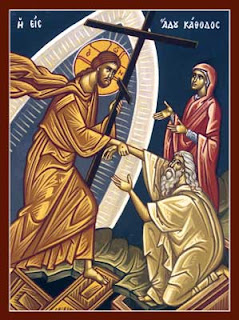
For Christ, the mystery of the Cross is the mystery of His
glory. The overwhelming suffering the Lord underwent, His psychological
torment at the injustice and crookedness of His trial, the desertion of His
disciples, the treachery of Judas, and the knowledge that the high priests had
agreed with one of His disciples to put a value of just thirty pieces of silver
on His life - all this was a path for Him to leave the world of passing
trivialities and enter into the glory of the Father. We, in every time
and place, must tread the same path. Matthew the Poor, The
Communion of Love


A marvelous thing is longsuffering; it places the soul as in
a quiet harbor, fleeing it from tossings and evil spirits. And this
everywhere Christ hath taught us, but especially now, when He is judged, and
dragged, and led about ....St. John Chrysostom
He is bruised and wounded, but He heals every disease and every
infirmity (Is. 53:23). He is lifted up and nailed to the tree,
but by the Tree of Life He restores us; yea, He saves even the robber
crucified with Him (Luke 23:43); yea, He wrapped the visible world in
darkness. He is given vinegar to drink. Who? He Who turned
the water into wine (John 2:1-11), Who is the Destroyer of the bitter taste, Who
is Sweetness and altogether desire. St. Gregory the Theologian
He lays down His life, but He has the power to take it again (John 10:18);
and the veil is torn in two, for the mysterious doors of heaven are opened, the
rocks are shattered, the dead arise (Matt. 27:51-53). He dies, but He
gives life; and by His death, destroys death. He is buried, but He
rises again. He goes down into Hell, but He brings up the souls. He
ascends to heaven, and shall come again to judge the living and the
dead. St. Gregory the Theologian

Wednesday, May 1, 2013
Make the effort...Jesus is merciful
Out of labor comes
health, out of sweat salvation. Beware lest, from your wish to keep certain
obligations, you break your obligation to God.
Do not sink back. There is
salvation; there is amendment. The doors
are not yet shut; the Bridegroom hears.
Make the effort. Jesus is
merciful, the Kingdom is at hand.
Subscribe to:
Posts (Atom)